

What Size Watercolor Quill Do I Need
Dislocated about watercolor brush sizes?
Watercolor brushes come in a confusingly wide range of sizes, shapes, and materials to choose from. One of the nigh bewildering characteristics of brushes is their size. What do all those numbers mean? 000 or 3/0 or fifty-fifty 1/64"?
Brushes are the tools that you use to communicate your artistic ambitions onto the paper. And good watercolor brushes are expensive. So it'due south well worth taking a bit of time to understand your tools.
In a nutshell… Brushes are sized according to a numbering arrangement. The most common brush sizes range from 000 (small-scale) to 24 (big). But there's a piffling more to it than that. Not all watercolor castor types use this numbered rule!
To help make things articulate in your mind I've put together this watercolor brush size chart - It's available to download as a PDF at the end of the commodity… Simply earlier we get to that, permit me explain a few technicalities.
The Anatomy of Watercolor Brushes
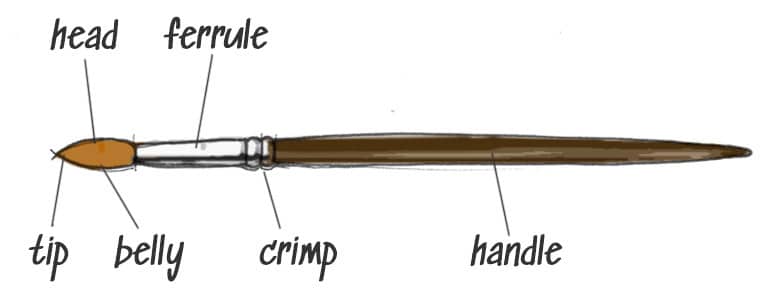
Brushes are made up of iii main parts. First comes the head (sometimes known as the tuft). The caput is made upwardly of bristles or hair and includes a belly and a tip. In watercolor painting, the belly is important considering this part holds the water. With a skilful watercolor brush you have to recharge your brush less often, and in turn, this provides a more fluid and continuous brushstroke. The tip should provide a sharp point which springs back naturally.
The head is held in place by the ferrule. The ferrule is a metallic neckband which needs to be well synthetic to prevent the hairs from falling out over fourth dimension. This is likewise the part of the brush that you hold, so it should exist comfortable. Depression-quality brushes take a seam considering they're made from folded metal. This is a cheap fabrication method and I always avoid brushes like this. The ferrule also does the job of protecting the wooden handle from moisture. It'southward attached to the handle by the crimp.
Handles are usually made from hardwood. The handle is printed with lots of fascinating data, including the brand, reference numbers and nigh importantly the SIZE!
Watercolor Brush Types
There are three widespread hair types for watercolor brushes - sable, squirrel and constructed. Sometimes you'll find less expensive brushes with a mixed combination of hairs. You will besides come across a wide diverseness of different shapes which are used for unlike techniques. The two nigh common shapes are round and flat. Below is a quick summary of the most frequently sold brush shapes, and a cursory description:
Just and so you know, this list is non exhaustive. Just why am I talking to yous about shapes ? The signal to remember is this... As mentioned above, brushes are classified by numbers. Only, the numbered brush sizes exercise non apply to all shapes of brushes. The number arrangement applies almost exclusively to ROUND and FLAT shapes of brushes. Other shapes of brushes are more often than not sized by their width and length.
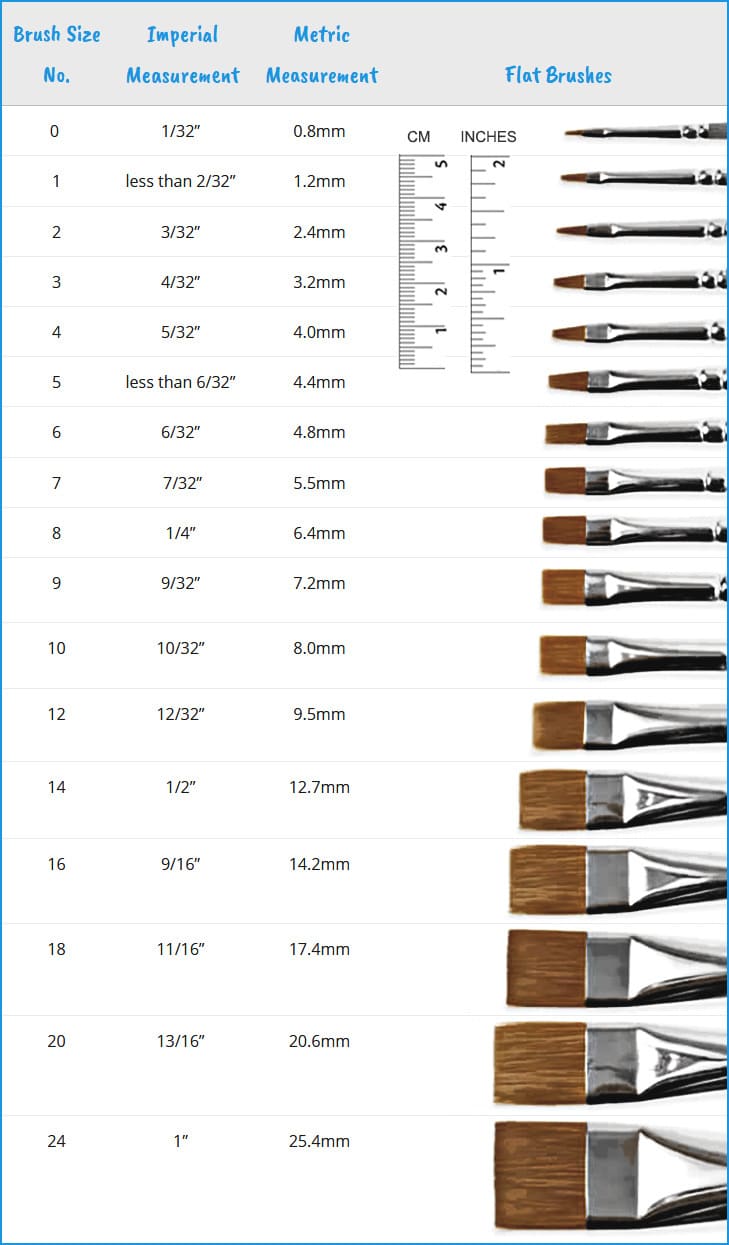
When information technology comes to flat brushes, half of the time you lot will exist given the size of the brush in terms of measurements. But so you know what these mean, the length of the brush ordinarily refers to the distance from the tip of the brush to the edge of the ferrule, where the ferrule ends and the hair begins. The width of the brush refers to the distance beyond the flat ferrule, at the exact point where the ferrule meets the hair.
Brush Sizing
Did you know that Her Majesty Queen Victoria had a favorite size of watercolor brush ?
The No. vii …
But you lot don't have to be of imperial blood to have a preference...
Unfortunately, brush sizes do not follow an internationally imposed measuring standard. Sizes for round and flat brushes are divers co-ordinate to a numbering system which tin can range from 0000 to 50. But these are the extremes. Personally, I have never seen a No. l brush! Fifty-fifty if I did, I wouldn't be able to afford it!
The numbers usually identify the relative sizes of brushes within the same type of brush and past the same manufacturer.
This numbering system is fairly standardized, merely sizes tin can vary slightly from one manufacturer to another. For example, a No. 10 brush from Winsor & Newton may not exist exactly the same size every bit a No.10 brush past da Vinci.
The Confusionarises because the sizing and numbering of circular and flat brushes tin be expressed differently from ane brand to another.
For instance, the smallest castor size is the No. 0000. But this tin too exist expressed every bit 4/0 (four zeros). Just to make things even more than baffling, a manufacturer might also add a measurement. So a four/0 brush is approximately equivalent to 1/64" or 0.4mm (oh yeah depending on where yous are in the globe, you lot've got imperial or metric measurements!)
Dislocated withal ?
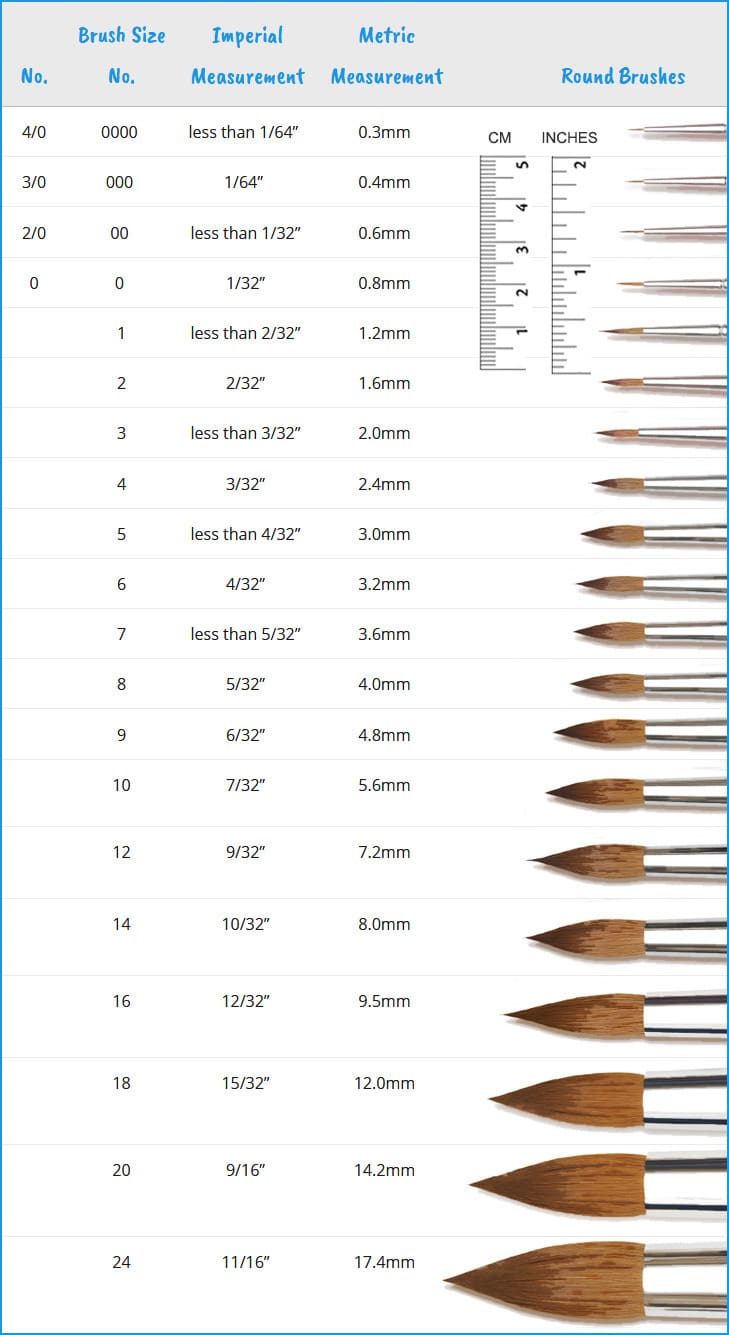
Don't worry. Below is a nautical chart which gives you a visual reference for the unlike sizes of brushes. This chart is based on the manufacturers' information that I was able to verify and should be considered as a guide to relative sizes of watercolor brushes. Unfortunately, considering sizes vary slightly from brand to brand, the chart lacks precision… But I hope information technology helps!
Watercolor Castor Size Nautical chart
Round Brush Sizes ( From Small to Big )
Like This ? Share in on Pinterest!
You may also discover that minor brush sizes increase by increments of 1 (for example i, 2, 3… etc.). When y'all reach size 10, larger brush sizes increase by increments of 2 (ten, 12, 14… etc.). This isn't an oversight. All of the brush manufacturers that I compared, size their brushes this style. I imagine this is for reasons of economy.
You will find that the size of the handles on watercolor brushes is smaller than brushes used for other medium, such as oil or acrylic. This is considering a lot of watercolor projects are on a small scale and require detailed work. The watercolorist holds the brush by the ferrule to achieve greater command, and then a large sized handle is not needed.
Flat Brush Sizes ( From Small to Large )
Like This ? Share in on Pinterest!
What Size Watercolor Brushes do I Need?
You lot won't need every size of castor! The best way to begin is to get a limited number of versatile brushes capable of performing a wide range of techniques. Consider detail work, wash piece of work, and furnishings.
Midsize circular brushes are the most versatile. Smaller round brushes will be needed for detailed piece of work and a large brush is proficient for broad strokes. So a selection of round brushes will give yous the best value (pocket-size, medium and big).
Also, information technology'due south a bit ho-hum and inconvenient to paint a whole painting with simply circular brushes, then for this reason it's a proficient add together some flat and wash brushes to your collection.
Brushes need to be skillful quality considering they should concur their shape, hold a expert corporeality of paint or h2o in their belly, be able to maintain a point, and distribute the medium smoothly.
Proficient brushes are expensive - just if yous choose your brushes carefully they will last for a very long time!
To quote Jacques Turner, from his book "Brushes: A Handbook for Artists and Artisans" :
Nearly artists are not fully aware of the influence the quality of their brushes has on the piece of work they do.... It is very difficult to obtain proficient results using badly made brushes. I have met beginners who were convinced that they lacked power because they were unable to produce certain painting effects, when in reality their failure was the direct effect of the junior brushes they were attempting to employ.


What Size Watercolor Quill Do I Need,
Source: https://www.watercoloraffair.com/watercolor-brush-size-chart/
Posted by: stewartruen1996.blogspot.com
0 Response to "What Size Watercolor Quill Do I Need"
Post a Comment